2.2 What's it like?
Like many people in Spain, Juan uses Whatsapp on his mobile phone. Take a look at these messages between Juan and his friend, Dave.
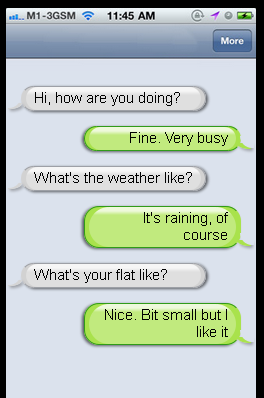
Imagen de elaboración propia con classtools.net

Focus on Grammar
Look at these examples from the WhatsApp.
What's the weather like? It's raining, of course
What's your flat like? Nice. (A) Bit small.
What + (be) + noun + like? = Describe this noun.
What are the English like? = Describe the English.
What is Joe like ?= Describe Joe's personality
NB: we only use like in the question, not the answer.
What is the weather like in Pamplona? It's very cold and wet.
What are the Germans like? They are very hard-working.
Don't confuse this with the phrase What+look like (describe physically).
 Actividad desplegable

Match the adjectives and their opposites
| talkative | |
| shy | |
| generous | |
| easygoing | |
| friendly | |
| lazy | |
| stupid | |
| optimistic |
Complete the sentences with the correct adjective.
1. Alistair's very - he got A's in all his subjects at school.
2. Our new teacher, Veronica, is really - she doesn't even let us talk in class!
3. "I'm sure I'm going to fail all my exams" "Hey, don't be so ! You'll be fine."
4. "Can I borrow £1? " "No" "Oh, come on, don't be so !"
5. Ana, the Chinese teacher, is really . She invited me over for coffee. The problem is she's so - I couldn't get a word in!
6. Alejandro hasn't asked anyone to dance- he's too .
7. Raquel is really - she never does anything. Her house is a mess.
8. Penelope is very - she starts at 8 o'clock in the morning and keeps going until 6 or 7 o'clock.
Listen and repeat the adjectives:
Rellenar huecos
Click on this link to practise the difference between like, be like and look like.
Listen to the dialogues. What was the question, A, B or C? :
A: What does she/he look like?
B: What does she/he like doing?
C: What is she/he like?
1. 5.
2. 6.
3. 7.
4. 8.
| A, B or C? | A, B or C? | ||
| 1. | 5. | ||
| 2. | 6. | ||
| 3. | 7. | ||
| 4. | 8. |


Actividad de lectura
|
To help you guess the meaning of an unknown word, you can: 1) decide if it is a verb, a noun, an adjective, etc. 2) look if it is similar to a word you alreday know in another language 3) use the context. Sometimes you don't need to know the exact meaning, only an approximate one.
Practice: Look at the underlined words in the sentences. Guess the meaning. 1.This knife is blunt- I can't cut with it. 2.I fell over and hurt my ankle. Now I can't walk. 3. I was cold in bed last night so I got another blanket. |
|

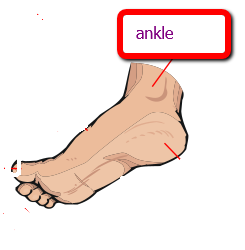 blanket